Curriculum Vitae
If the PDF does not load, you can open it in a new tab .
Education / Bio
Short Bio
I am a Banting postdoctoral fellow at the Trottier Space Institute & Physics Department at McGill University and hold a guest affiliation at the University of Amsterdam's Anton Pannekoek Institute for Astronomy (UvA API). I am also a foundational member of the CHIME/FRB Collaboration. My research interests include fast radio bursts, high-energy follow up, and circumgalactic media, particularly in the context of astrostatistics. I also currently hold the record for most FRB sources discovered during a PhD. I received my PhD in Astrophysics from the University of Toronto in 2025, and an honours BSc in mathematics and physics from McGill University in 2019. As an undergrad I held a variety of summer research positions including at NASA JPL and the University of Kyoto.
Doctoral
I received my Ph.D. in Astronomy and Astrophysics from the David A. Dunlap Department of Astronomy and Astrophysics at the University of Toronto in January of 2025. My thesis was entitled "Fast Radio Burst statistics in time and space: FRB repetition patterns and the Milky Way’s plasma probed by CHIME/FRB" and it was supervised by Prof. Gwen Eadie, Prof. Bryan Gaensler, and Prof. Paul Scholz. It can be found here .
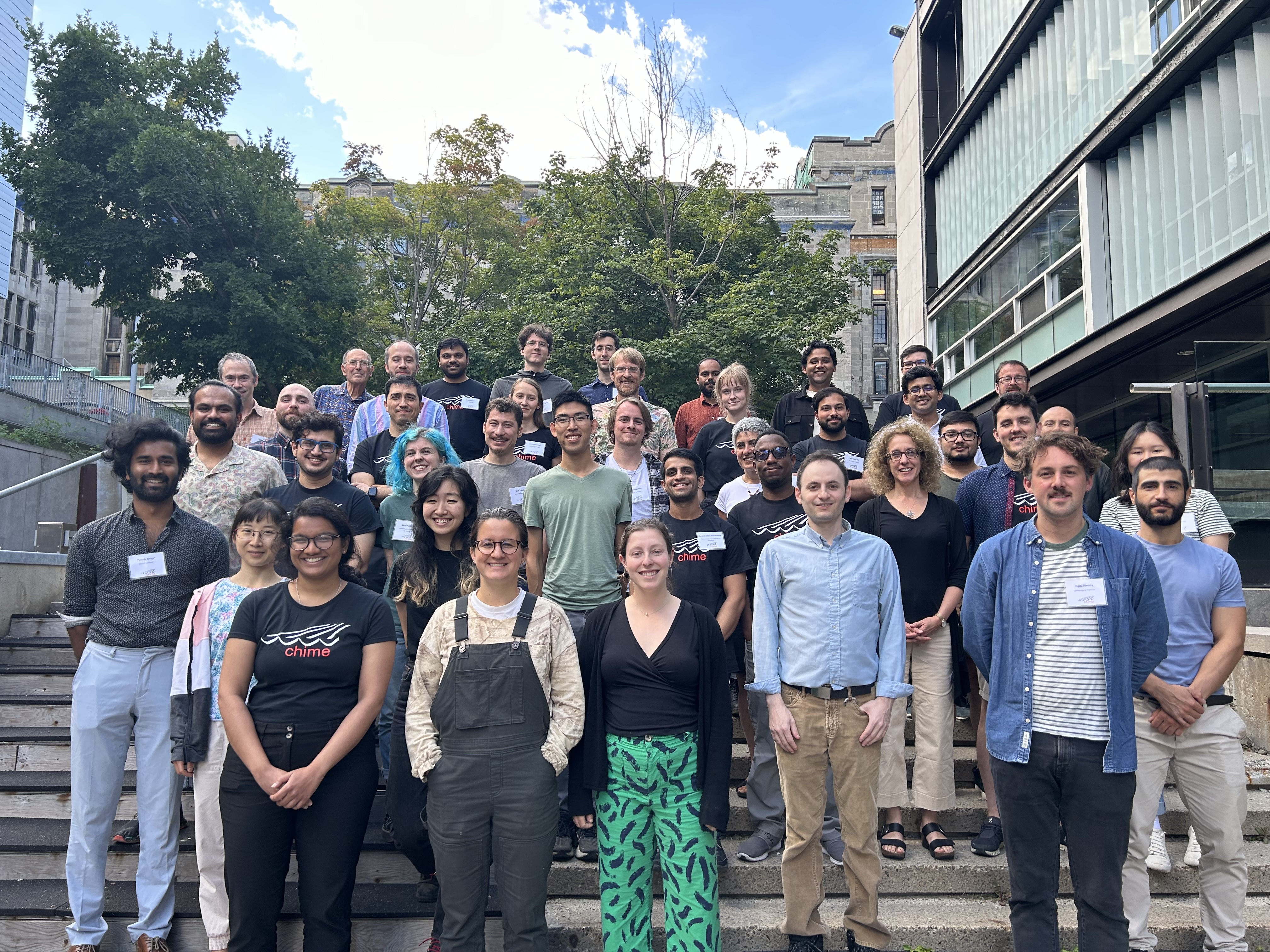
I was a member of the CHIME/FRB collaboration throughout my Ph.D., and was one of two trainees funded by a Canadian Statistical Sciences Institute Collaborative Research Grant (CANSSI CRT) which was awarded to Gwen, Bryan, Prof. Derek Bingham, and Prof. David Stenning to work on novel statistical problems posed by CHIME/FRB's unique design.
Undergraduate
I was an undergraduate student at McGill University from 2015 to 2019, where I was enrolled in the Joint Honours Mathematics and Physics program. In the summer of 2017, I worked with Prof. Ken Ragan (McGill) on my first-ever research project, a study of a Crab-like young pulsar using Fermi-LAT data. This work was published in an undergraduate research journal.
The following summer, I worked as a Caltech/NASA JPL summer intern with Dr. Walid Majid and Ph.D. students Aaron Pearlman and Chris Bochenek. The project was originally to search for FRBs in 1000 hours of data from the Deep Space Network's 70-m radio telescopes. However, I started with a rough calculation, and we realized that because of the telescopes' very small field of view, we didn't expect to find any FRBs in that dataset, despite the large number of hours and the high sensitivity. A search confirmed this. Instead, I worked on a multi-wavelength (radio and X-ray) campaign to monitor the recently reactivated Galactic radio magnetar PSR J1622−4950.
When I returned to McGill University that fall, given my background in fast radio bursts, magnetars, and X-ray and radio observations, it was only natural that I began to work with Prof. Vicky Kaspi and her then Ph.D. student Ziggy Pleunis. For my honours undergraduate thesis, I characterized CHIME/FRB's false-positive rate on the Galactic plane and predicted how often a Galactic magnetar would flare detectably in CHIME/FRB's field of view (above a declination of −11°). I remember being told at one of my first meetings with Vicky that CHIME/FRB had already detected ~40 new FRB sources, and being completely astonished.
As my final undergraduate research project before starting graduate school, I worked with Prof. Teru Enoto at Kyoto University to develop a search pipeline for periodic emission from magnetars observed by the Neutron star Interior Composition ExploreR (NICER).